Pages

Saturday, August 6, 2016

How we knew

At this point you may be wondering how we could have known that J. had Infantile Spasms to begin with? As I mentioned in my previous post, though heartbroken, we were not surprised by her diagnosis. That story really begins when J. was one month old.
J. was born by C-section at 39 weeks and 1 day. She was 7 lbs 15 oz. A beautiful, healthy baby girl. Her birth was uneventful. She had difficulty nursing due to a tongue tie we opted out of correcting. Because of this, she was half breast fed and half formula fed until 5 months. In the hospital, she lost some weight initially. Some of the nurses were concerned and some weren’t. My C-section was bumped twice by emergency Cs, so instead of going in at 8:00am we went at 12:30pm. All the while we waited, I was receiving intravenous fluids for hydration. One nurse theorized that J.’s birthweight was inflated because of the extra fluids and that most of what she shed (13 oz in the hospital) was due to this. We agreed, that made sense to us. Still, she was jaundiced as well, so they had us supplement with formula. Once her weight came back up, I laid off the formula for a while, but succumbing to the pressures of exclusively pumping, we incorporated it back into our feeding routine at about 3 weeks.
After all of that, J.’s weight gain really took off. She’s always been a great eater, a good sleeper, and she gains steadily. She’s now somewhere between the 97th and 100th percentile for weight, and pretty high on the height scale, too. I was a heavy baby and am now thin and average height. Dad was a heavy baby and is now thin, but also 6’4”, so it’s really no wonder where Baby J.s’ size comes from.
Her first month of life was magical. I felt energized, happy. She was a calm, relaxed baby. Loved to snuggle. Never cried, unless she was hungry. We had to set alarms to wake us up, to wake her up for feedings because she would sleep for hours.
Around 6 weeks though, things began to fall apart. J. became very colicky. She cried for hours every evening and was fussy all day (that is, when she wasn’t sleeping, which she did a lot). This went on and we took solace in the notion that colic usually ends around 4 months.
At around 2 months, I started worrying about her eyesight. She never gazed at us as other babies would do. I had a friend whose son was two weeks older than J. We would go for walks in the park and he would be so distracted by his surroundings that he couldn’t concentrate on eating. By contrast, J. would stare downward, blankly. Not at me, or at the trees, just at nothing. I tried to discuss this with others--I posted on mom boards and brought it up to my partner and my friends and family--but everyone agreed it was too early to worry.
At 13 weeks she started daycare two days a week. She would be screaming every time I picked her up and it would last until she went to bed. It got to the point where the daycare teachers would meet me at the door with her and her things to get her out as quickly as possible. They were always polite about it, but the reports were usually that she’d been fussy all day.
The 4 month mark came and went and there was no change. She was still grouchy and still not making eye contact, or tracking her toys.
We took her to a pediatric ophthalmologist and that’s when the possibility of ONH was first presented to us. We were beyond devastated. On top of that, the doctor really wanted J. to have an MRI for which she would need to be put under general anesthesia. The MRI was scheduled for June 16th and J. would be only 5 months old. We panicked, briefly, and then I went into planning mode. I gathered as much information about what ONH was and what resources we would require and then I scheduled a second opinion.
That doctor asked me not to disclose was the first doctor had suggested was wrong with J. before he had a chance to assess her. Ultimately, he decided that J.’s optic nerves looked normal to him. We cancelled the MRI.
A second visit to the first ophthalmologist 2 months later produced the same conclusion. He even told us that he felt sure that J. had Delayed Visual Maturation and that her vision would soon begin to improve.
That was two days before we were admitted to the hospital.
While all of this was happening, J.’s mood had improved some. For a couple of weeks after she hit the 5 month mark she was a whole new kid. A week or two before we were admitted, however, things had begun to regress. She was becoming irritable again, she was smiling much less (at most, one smile a day) and babbling much less. She wasn’t standing up as well. She was slumping over, having trouble holding up her head. She was sleeping a lot.
Wednesday evening, after the last ophtho visit, while sitting in our living room we noticed something strange. My partner was holding J. in a sitting position on the floor and all of a sudden she shrugged her shoulders and pushed backward. We definitely noticed it and thought it was weird--we’d never seen her do something like that before--but it was just once or twice so we sort of ignored it. .
The next evening we were lying in bed with her, again my partner was holding her in a sitting position, this time on his lap and she did the same motion again. She did it a couple of times and then stopped, but this time I noticed she was pointing her toes and I knew that couldn’t be good. It wasn’t normal. I Googled “muscle spasms in babies” and the first several results were for Infantile Spasms. I read about it, but the descriptions of the spasms there didn’t sound exactly like what J. was doing. Also, it’s very rare. I didn’t even tell T. what I had read. I decided just to wait and see if the movements ceased.
The next morning, while at work, I received a text from T. asking what I had read about J.’s strange ticks. I told him that I’d read they could be seizures. He said she’d had another bout of them but this time she’d become really upset and cried. I lost all focus. I hardly did any work that day. I spent all day reading about IS and watching videos of children doing exactly the same thing J. had been doing. How I managed to keep it together until the end of my shift, I’ll never know. T. took her to the pediatrician and when I got home he told me we were going to the hospital. We packed up and left, completely unaware of just how drastically our lives were about to change.
In hindsight, all of J.’s abnormal behaviors--which we had attributed to different afflictions--can be traced back to her IS. J.’s vision therapist now believes that J. has cerebral visual impairment (CVI), a fairly common side effect of seizure disorders. Children with IS are often misdiagnosed with colic, and looking back, J. had other bizarre tics that very well could have been seizures (staring blankly for seconds at a time, head bobbing (which can also be attributed to her blindness), bowing the head and bring the hands up in a prayer-like position). Of course, I wish we would’ve known then that these were something to be concerned about, but there is no way we could have known. Our neuro team praised us for noticing her spasms as early as we did. They told us that she received the earliest possible diagnosis.
The most frustrating part is that I have always known there was something off about J. but I could not put my finger on the issue. It seemed so unlikely to me that J. happened to have vision problems, poor head control and colic and they weren’t related (plus she has always napped a lot, she had a chronic cough and was constantly--I mean constantly--rubbing her eyes). I knew that she wasn’t behaving like a normal baby and I hate that I was always told I was just experiencing normal new-mom anxiety. I was anxious. Very, in fact, I was constantly having terrible visions in my head of things happening to J., of her getting hurt, and I was constantly checking on her to make sure she was breathing. I was barely functional. Ever since she was diagnosed, however, that anxiety has abated quite a bit. One would think I’d be more nervous now that I have empirical evidence that there is something wrong with my child but I have always known there was, and now I know what it is so I can work with that. I still have my days, but it’s much better.
As a mother who has been there, my advice to you, if you are following our journey because you’re worried about your own child, is say something. Even if you can’t explain why your child does not seem right to you, trust your instinct. I wish I had. If nothing else, you will be able to say that you tried and maybe the doctor will put your mind at ease.

Wednesday, August 3, 2016

What is "Infantile Spasms"?

Disclaimer: I am not a doctor and I do not have any medical training. In this post I am going to discuss my own understanding of and experience with Infantile Spasms, but I am by no means an expert. Quite the opposite, I am learning more about this condition every day. I implore you to do your research. If you are concerned that your child has IS, or is having seizures, contact your pediatrician, or go to the ER, right away. Don’t wait. This is a serious medical condition that needs immediate diagnosis and treatment for the best prognosis.


Infantile Spasms
The first thing you should know about Infantile Spasms is that it is extremely rare. There are only about 2,500 new cases in the US each year. This seems like a lot when you are worrying about your child . . . until you consider that there are 318.9 million people in the US and there were about 3.9 million babies born in the US in 2014. That means, IS affects only approximately .06% of US babies born each year.
IS is form of epilepsy that affects children in the first year of life. The onset is typically between 4 and 8 months and outcomes vary widely. There are a lot of factors that play into the prognosis for a child with IS. The biggest factor is what underlying condition is causing it and how severe is that condition? If the cause can be determined, that’s called “symptomatic” IS. If one cannot be determined, this is called “cryptogenic” IS (this doesn’t mean that there isn’t a cause--there almost always is--it just means the cause can’t be found).
So far, Baby J.’s case is cryptogenic. We have not been able to determine what has caused her spasms (though we are still waiting on some test results). There was concern that Optic Nerve Hypoplasia (small optic nerves) may be the cause. J. has had impaired vision, as far as we can tell, since birth. However, we have seen two pediatric ophthalmologists, and they’ve both said that, from the front, her optic nerves look normal. J. had an MRI while in the hospital which would have showed any damage or defect of the back of the optic nerve, but it came out clean.
The MRI did not show any other abnormalities of the brain, either. So far, genetic and metabolic blood tests have not given us any answers. Our neurologist has told us that as long as J. responds to the seizure medication, there won’t be cause to look deeper. Subsequent and more specific tests could be ordered, but they are expensive and, as long as J.’s condition appears to be improving, they are unnecessary.
IS can be caused by a plethora of conditions. Perhaps the most concerning are defects of the brain, such as a tumor, encephalopathy, hypoplasia, traumatic brain injury or prolonged lack of oxygen to the brain (such as a near miss SIDS episode). There are also many genetic and metabolic diseases that can cause IS. The reason the prognosis for a child with symptomatic IS is not as positive, is because the condition itself will also require treatment and may carry its own undesirable prognosis.
In a child with cryptogenic IS, only the seizures need to (and can) be treated. Once the seizures are under control, the child can begin receiving therapy for any resulting delays.
A diagnosis of cryptogenic IS does not preserve the child from the possibility of developing other kinds of epilepsy or autism, or learning disabilities later in life. The damage has been done and the stage set, but these conditions, as I understand it, are less likely outcomes, if only slightly.


What to look for
The second thing you should know about IS is what to look for. IS spasms typically occur when a child is waking up, or getting sleepy. J. had hers when she got up in the morning and before bed at night and sometimes in the middle of the day.
The spasms are small, abnormal movements that happen in succession. J.’s spasms always looked the same, but varied in severity. The more severe, the more upset she would become between spasms, during an episode (or “spell”). Her shoulders would shrug, her arms would come forward as though someone were pulling her hands, she would point her toes and, for the duration of each spasm, her eyes would glass over. Each spell or series of spasms would last anywhere from 5-10 minutes (though they may go on longer) and each spasm was 1-5 seconds, 15-20 second apart. It is heart-wrenching to watch your baby go through this, even more so if they are also becoming upset.
There is nothing that you can do to stop a spasm when it’s happening, but it’s more than okay to hold and comfort you baby. They need you.
The spasms present in many different ways. As hard as they are to watch, I recommend looking for some videos others have posted of their babies having spasms and compare to what you have seen in your own child. This really helped us to conclude that we needed to see our pediatrician immediately. I have thought long and hard about posting a video of J. going through a spasm, because I know it would help so many, but I have opted out, out of respect for her privacy. I feel that this blog tells enough of the story.
On that note, I highly, highly recommend that you record your child the first few times they have an episode (the more examples you have the better). All of your doctors will appreciate seeing this, because they may not have the opportunity to witness an episode in person. All of our doctors were impressed and grateful that we (by which I mean T.) had the wherewithal to record J.’s spasms.
J. usually fell asleep after an episode. The worse the spasms, the longer and more deeply she would sleep. She had a particularly severe episode on the way to the hospital and slept right through having the EEG leads attached, which took about 45 minutes.


How IS is diagnosed
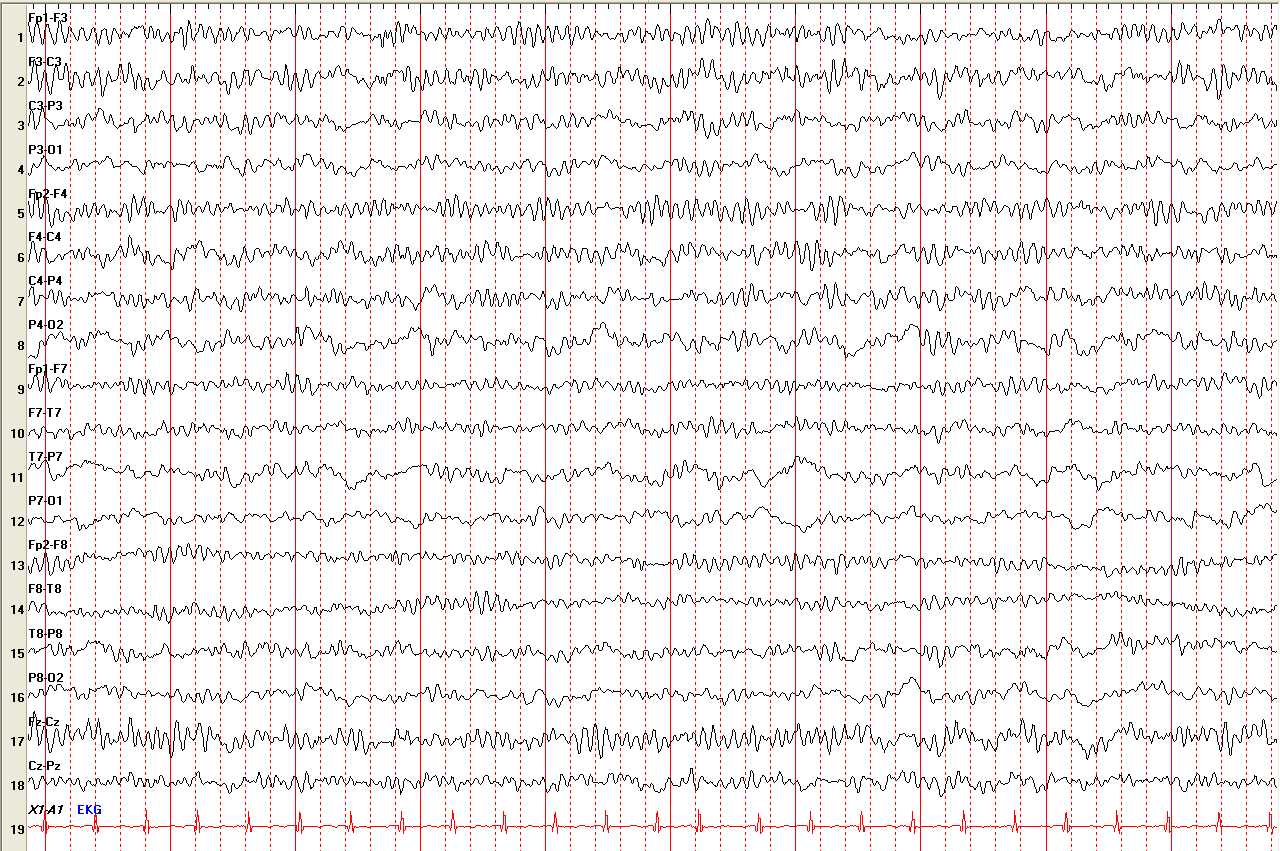
IS is diagnosed by an electroencephalogram (EEG). This is an EKG for the brain. A number of leads are glued to the head (over the hair) and are connected to wires which are connected to a computer. The monitor shows a series of a lines. In a child with normal brain activity, these lines will have consistent peaks and valleys that don’t cross. Unfortunately, in J.’s case, a problem was immediately apparent. Her EEG was chaotic. The lines had high peaks and deep valleys that changed every few seconds and crossed over each other in multiple places. This sort of brain activity is called hypsarrythmia and is, as it was explained to us, the inside-the-brain version of the spasms J. was having.
It was very clear to us, looking at the storm going on in her brain, why J. was falling behind in her development, why she was crabby all of the time, why her eyes and brain can’t communicate. I have no idea what it feels like to have that much disorganized activity in going on in your brain, but I can’t imagine it feels good.
While J. was hooked up to the EEG, she was also being monitored by camera, so that when the EEG showed she was having an episode, the doctors could see what she was doing at the time. J. was hooked up to hers from Friday evening until Monday morning (when the leads had to be removed for her MRI), but the typical time is 48 hours. Once finished, the leads are removed with a solution that dissolves the glue (so it doesn’t rip out the hair--I was really worried about this). You’ll need to wash your baby’s hair immediately after, so the solution doesn’t get on their hands and into their mouth or eyes.
After the diagnosis
ACTH is the first treatment doctors go to for IS, unless they already know the underlying cause. If a condition is identified, your doctor may opt to treat that first, as IS is symptom of that problem. In J.’s case, as I mentioned before, a reason for the IS has not yet been found so we are treating the IS itself. I will talk more about the medication in another post, but if your child is started on treatment while still on the EEG do not expect to see a difference in the readout. J. remained hooked up to the EEG for over 24 hours after the medication was started, and while her spasms seemed immediately reduced, the EEG remained unchanged. It takes several days, and possibly a couple of weeks, for that much improvement to be evident. (Also, you can’t expect to see an immediate response, as we did with J., concerning the actual spasms once on the medication, either--every child is different. The neuro team told us not to expect her seizures to be affected for 6-7 days. It did take 6 days for J.’s seizures to stop completely, but we saw a noticeable decrease in the number and severity of her seizures right away.)
During our stay in the hospital, we were visited by a team of neurologists every morning who would check in on J. and talk about any new concerns, or discoveries in her case. We were visited several times a day by J.’s nurses (who, at NYP, were just incredible and so so supportive!). The nurse would take vitals and help us administer J.’s medications (we had to be taught to give her an injection).
Depending on the hospital you are staying at, and how long you are there, you may also be visited by a Child Life Specialist. A CLS’s main job is to support children who are undergoing surgery or a difficult diagnosis, but they are also there to help you, as a parent, cope with having your child in the hospital.
We were also visited by a Care Coordinator, whose job it was to collect all the information we would need to continue caring for J. upon our release and put us in touch with an Early Intervention program. We were visited by a Social Worker, who wrote us letters explaining our absences from work for our employers. And we were visited by the visiting nurse coordinator who set us up with a nurse to come to our house and monitor J.’s blood pressure, blood sugar levels and her weight (all of which can be adversely affected by the ACTH).
Once the medications are obtained, you will be discharged from the hospital and sent home. This, by the way, may be when it will really hit you that your life will never be the same, so prepare yourself for that. Giving the medications to your child at home is quite different from giving them in the hospital. It’s much harder, emotionally, the first few times.
If you are living in the state of New York (as we do) you will be automatically eligible for Early Intervention services which are provided to you at no cost through the government--you just need a referral from your doctor. If you do not live in New York, ask your doctor what kind of services, if any, are available to you. If your state or local government do not provide these services, find out from your insurance company what kinds of therapies are covered.
And take a deep breath. IS is a hard diagnosis to hear, but your baby needs you to be strong. This is not to say that you shouldn’t break down, or call on friends and family for support. You probably will break down and you need all the support you can get, but don’t let this consume you. The worst part of this diagnosis is the uncertainty of the prognosis, so take everything one day at time.

This where I would like to invite you to e-mail me if you have any questions, or if you need someone who has been there to talk to. I will reiterate that I am not an expert, but I am happy to help in any way that I can. You are not alone.

Saturday, July 30, 2016

"This is not the Good News room."

“This will be the worst news you’ll ever receive.” The neurologist at New York Presbyterian said something along those lines when we sat down together in the family lounge of the pediatric ward, just a few doors down from where our 6 month old daughter was being babysat by her nurses.
It was a hot, sunny Saturday--a beautiful day--but years from now, when we look back on this moment, all we’ll remember about it is how cold and empty we felt. Dr. Kosofsky went on to tell us that our baby--our precious baby--was diagnosed with Infantile Spasms.
He didn’t have to tell us what that meant. We had done our homework before we brought her in.
T. and I held each other’s hands in silence. I don’t know if the doctor had expected us to cry just then, but we didn’t. We couldn’t feel it yet. “It’s good that you’ve read about it already,” he said, “You already know what to expect.”
But we didn’t know what to expect. We’d read about it, sure, but we were in denial. Up until that moment we were still certain that, even though the diagnoses fit our daughter to a tee, even though there was no other explanation that made sense, this couldn’t be happening to us.


Infantile Spasms is a cute name for one of the worst kinds of epilepsy. It’s rare, only 2,500 new cases occur in the US each year.
The “spasms” as they are called, are often subtle and hard to detect. The first spasm Baby J. had looked like a regular, jerky, baby move. She was sitting upright (with help) on the living room floor and she suddenly shrugged her shoulders and leaned back. She did this a couple of times and we said to each other, “That’s a funny move, she’s never done that before.” And we forgot about it. Until the next day, when this tick became more pronounced, and rhythmic, occurring in episodes. I noticed that with the shrugs, J. was pointing her toes. Her eyes became glassy. And with her third and fourth episodes, she cried between the spasms. Something was not right.
T. took J. to the pediatrician while I was at work. When I got home he informed me that Dr. Nick wanted us to take J. to the ER so we could be admitted as quickly as possible. No time to wait for an appointment. We hastily packed our bags and hopped on the subway.
J. was admitted and hooked up to an EEG right away. An electroencephalogram reads brainwaves. J.’s read like seismograph during a magnitude 8 earthquake. What should have been even peaks and valleys, were high points and plummets, all mixed together and crossing each other. I didn’t have to know anything about EEG readings to know that hers looked bad.
We were placed in a room with a camera where J. could be observed. We were directed to press a button if we saw a spasm which would mark it on the EEG . We were given a hard, pull-out chair to sleep T. and I both, about ⅔ the width of a twin bed. We were exhausted, but we hardly slept.
At one point I remember waking up in the middle of the night to see six doctors quietly discussing J.’s EEG in the dark. I’ve never seen so many doctors in one room. I knew at that moment that our lives were changing.
The next morning a nurse came in a said that the pediatric neurologist would be coming by to take us elsewhere to talk, and that she would stay with J. Shortly thereafter, we were escorted by the attending pediatric neurologist and his resident to the family lounge at the end of the hall. T. and I held hands. I looked at him and said, “This is not the Good News room.” I expected him, ever the optimist, to allay my fears and tell me that it was going to be fine. To give me some other reason they wanted to discuss J. with us privately. He didn’t. Instead, he simply said, “No, it’s not.”
We didn’t have many questions for the neurologists. Only one, in fact: “What do we do next?” He told us mostly things we already knew. J. would need more tests to try to determine if there was a cause for her IS. He told us that if a cause is found, it’s called “symptomatic” IS. He felt strongly that J.’s case would be symptomatic because she was already experiencing some delays in her development, and she has vision problems (I’ll discuss this in another post).
However, if a cause couldn’t be found, it could be called “cryptogenic,” for which the prognosis is typically better.
J.’s MRI was scheduled for the following Monday. She would remain on the EEG until then and we would start the dreaded ACTH as soon as possible. When the neurologists left, T. and I held each other. We cried then. We called our parents and asked them to come. We called our employers and told them we didn’t know when we’d be back to work. We put our lives on pause, and asked our families to do the same.
Our daughter was sick. Our impossibly beautiful baby girl. It was hard to go back to her. I didn’t want to look at her differently than I had before. I wanted her to be the same.
Even so, the moment I stepped back into my daughter’s hospital room I pulled myself together. I picked her up and kissed her, I smiled, I bounced her. I didn’t let her hear in my voice the pain that was in my heart.
The first few days with J.’s diagnosis were, of course, the hardest. I found myself desperately wishing we could just go home and pretend none of this ever happened. T. and I even joked (very morbidly) about the three of us jumping off a bridge. All kinds of terrible thoughts run through your head. You think about all the really half-witted parents you know who were somehow blessed with perfect children. You think of all the things you might have done wrong during your pregnancy. You ache for a reason. Why is this happening to us? I kept thinking, if only we could start all over again, have a different baby . . . but that killed me. I didn’t want a different baby. I wanted my baby, I just wanted her to be well. People are not fooling around when they tell you receiving news of this magnitude is like being stuck in a nightmare you can’t wake up from. That is exactly how it feels.

As I write this, we have now had two weeks to digest. We’re back home and navigating the Early Intervention process. The one good thing about a serious diagnosis such as this is that we don’t have a lot of time to feel sorry for ourselves. This isn’t happening to us, after all, it’s happening to our child, and she needs us to do all of the appointment-setting, organizing, research, and phone calls for her, and there is a whole lot of that. Most importantly of all, she needs our unconditional love, because she didn’t ask to be born, but she was, and she didn’t ask to have a medical condition, but she does. It’s unfair for all involved, but for no one more than my Goober Pea. It’s easy to be strong for her. It’s my #1 job, now and always.

So, when people ask me how we’re doing I just say, “We’re taking it one day at a time.” That’s all we can do. Life goes on.

Welcome to GooberPeas

Welcome! You have likely come across this blog because you are concerned about your child and you're looking for more information about Infantile Spasms or CVI (cerebral [cortical] visual impairment). If this is the case, I extend my sincerest sympathies. I know a little of what you are going through, because I have been there.
I will reiterate this periodically throughout the blog: I am not a doctor, nor am I an expert on IS, CVI or any other medical condition. I have no medical training. Our daughter was just diagnosed on July 16th, 2016, so we're new at this whole thing.
In this blog I will discuss my personal understanding of the conditions my daughter has been diagnosed with, as well as our personal experience accepting her diagnosis, and treating her conditions.
If you have any questions, or need an ear (or an eye), please e-mail me at goober peas the blog @ gmail.com.